What Actually Causes Failed Deliveries And How Logistics Teams Reduce Them
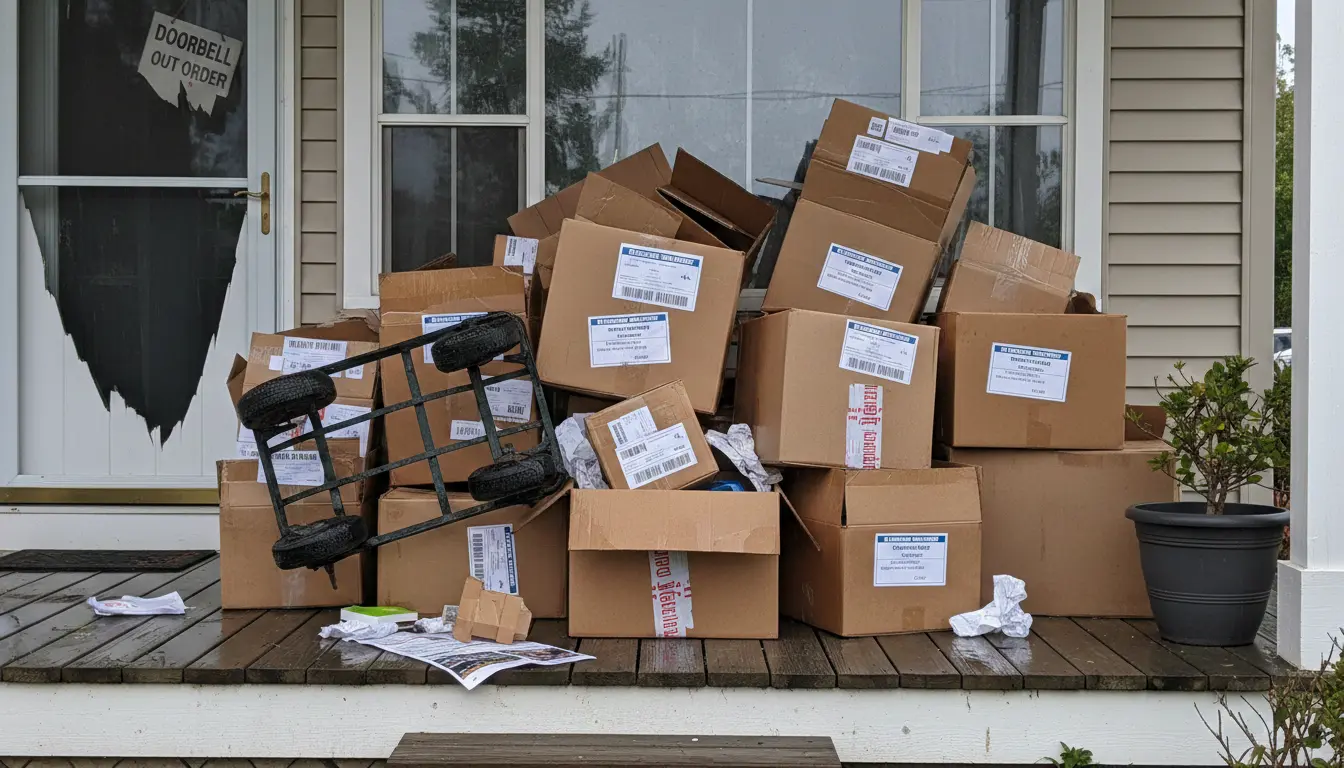
Logistics teams provide assistance for preventing failed deliveries in some unexpected ways.
And while failed deliveries are not ever possible to completely avoid, there are ways to lessen them.
Failed deliveries are one of those problems that can feel impossible to pin down because the causes are scattered across the entire supply chain.
But here's the thing: most of them are preventable.
Once you understand what's actually going wrong, you can start making targeted changes that have a real impact on your delivery success rate, your costs, and your customer experience.
Let's break down the most common causes of failed deliveries and, more importantly, what high-performing supply chain teams are doing to reduce them.
What Counts as a Failed Freight Services Delivery?
A failed delivery is pretty much any shipment that doesn't make it to the right person, on time or at all.
That could mean a package sitting uncollected at a depot, a driver turning up to an empty house, goods going to the wrong address entirely, or something arriving damaged.
Sometimes it's the right address but completely the wrong item.
Each of these situations costs you — in redelivery fees, customer service hours, and the kind of slow trust erosion that's hard to win back.
When you dig into why these failures happen, they tend to fall into four broad buckets: data errors, inventory and warehouse issues, communication breakdowns, and external disruptions.
And honestly, most failed deliveries aren't caused by just one thing. It's usually a combination.
Data and Documentation Errors in Delivery Solutions
If your delivery data is wrong, everything downstream unfortunately suffers.
You'll commonly see that aspects like incorrect addresses, outdated customer information, and flawed paperwork are among the top factors behind misrouted packages and customs holds.
These are the kinds of mistakes that seem small in isolation but compound quickly at scale.
The unpleasant truth is that most data errors are introduced by humans during order processing. They're not malicious; they're just the natural result of repetitive manual work done under time pressure.
Communication and Human Factors
Logistics depends on a lot of people working in sync.
When communication breaks down — between departments, drivers, carriers, or customers — small misunderstandings have a way of becoming delivery failures.
Common Communication Problems
Internal miscommunication: Sales quotes a delivery window that operations can't actually meet. The warehouse packs an order based on instructions that were updated two days ago. Dispatch doesn't pass a route change on to the driver. These gaps between teams create confusion that ultimately lands on the customer's doorstep — sometimes literally.
External miscommunication: Customers give vague delivery instructions, or they simply don't know when to expect their package. Most "not home" failures aren't inevitable — a simple notification sent at the right time would have prevented them.
Human error in routing and booking: When drivers or dispatchers are manually planning routes or logging jobs, fatigue creeps in. A delivery gets assigned to the wrong driver, a time window gets overlooked, a special handling note gets missed. It happens.
The pattern is consistent: wherever a process relies on someone remembering a detail or manually moving information between systems, there's a real chance something gets dropped.
Route and External Disruptions
Some causes of failed deliveries are outside your direct control, but that doesn't mean they're outside your ability to plan for.
What Disrupts Deliveries on the Road?
Poor route planning: Manual route optimisation often ignores real-time traffic conditions, weather forecasts, or known congestion points. The result is drivers arriving late, missing delivery windows, and burning through fuel unnecessarily.
Weather, traffic, and infrastructure: Storms, accidents, roadworks, and city congestion can halt fleets or slow them to a crawl. These are the disturbances that everyone acknowledges but few teams proactively plan around.
Customs and compliance hurdles: For international shipments, incomplete documentation as well as restricted goods classifications can hold packages at the border indefinitely.
Peak demand and system overload: Holidays, promotional events, and seasonal spikes can overwhelm carrier capacity. If you haven't planned for surge volumes, deliveries fall through the cracks.
How Supply Chain Teams Actually Reduce Failed Deliveries
Understanding the causes is useful. But the more practical question is: what do you actually do about them?
The teams with consistently low failure rates aren't just fortunate. They've built processes and systems that catch problems early — and when things do go wrong, they recover quickly.
Automate Records Entry and Validation
Removing manual data entry from the process wherever possible is probably the biggest single improvement most teams can make.
Address validation software catches typos and fills in missing details before a package leaves the warehouse.
Automated label generation takes handwriting out of the equation.
Systems that pull customer data directly from the order platform mean information doesn't have to be re-keyed three times by three different people.
This isn't about replacing your team. It's about freeing them from the repetitive work that's most likely to produce errors.
Implement Real-Time Inventory Tracking
If your inventory system isn't reflecting what's actually on the shelf right now, you'll keep making delivery promises you can't keep.
Real-time tracking means that when a customer places an order, the system confirms the item is available, located, and ready to pick — not just that it should be there in theory.
Optimise Routes with Technology
Manual route planning made sense when volumes were lower and customers were more forgiving. That's not really the case anymore.
AI-driven route optimisation factors in traffic, weather, delivery windows, and vehicle capacity to build routes that hold up in real conditions. The gap between a manually planned route and an optimised one can be the difference between hitting 90% of your delivery windows and hitting 98%.
That difference compounds significantly when you're trying to build lasting customer loyalty.
Strengthen Communication Across the Chain
Live tracking and automated customer notifications aren't premium features anymore — they're expected.
When customers know exactly when their delivery is arriving, "not home" failures drop considerably.
When drivers have an app giving them live updates, special instructions, and a direct line to dispatch, they can adapt on the fly rather than discovering a problem at the door.
Internally, clear handoff protocols between sales, warehouse, and dispatch prevent the kind of miscommunication that causes wrong items or missed windows in the first place.
Build Resilient Operations
The best logistics units don't just optimise for the sunny-day scenario. They build in buffers and backup plans.
- Partner with reliable carriers: Vet your carrier partners for capacity, vehicle maintenance standards, and communication responsiveness. A cheap carrier that fails 15% of deliveries is far more expensive than a slightly pricier one that fails 3%.
- Train staff consistently: Regular training on systems, processes, and exception handling keeps error rates low. New hires should shadow experienced team members before handling deliveries independently.
- Have contingency plans: What happens when a vehicle breaks down? When a storm closes a major route? When your primary system goes offline? Teams that have rehearsed these scenarios recover faster than those figuring it out in the moment.
- Use Proof of Delivery: Proof of Delivery apps that record photos, signatures, and timestamps resolve disputes quickly and give you data for identifying patterns in delivery failures. If the same address keeps generating "not delivered" claims, you can investigate and fix the underlying issue.
What Kind of Improvement Can You Expect?
Teams that implement integrated technology stacks covering route optimisation, live tracking, automated notifications, and proof of delivery often see failed delivery rates drop by 20–50%.
That's not a theoretical number pulled from a whitepaper. It's the kind of result that comes from eliminating the manual handoffs, data gaps, and communication lapses that cause most failures.
The financial effect is considerable too.
Every failed delivery carries costs in redelivery attempts, customer service calls, returned goods processing, and lost future revenue from dissatisfied customers.
Reducing your failure rate by even a few percentage points can translate into meaningful savings across a fleet.
Frequently Asked Questions
What is the most common cause of failed deliveries?
Incorrect or incomplete address data is consistently one of the leading causes. A misspelling in a street name, a missing unit number, or an outdated postcode can send a package to the wrong location entirely. Address validation tools catch most of these errors before dispatch.
How does route optimisation reduce delivery failures?
Route optimisation software factors in real-time traffic, weather, delivery windows, and vehicle capacity to create routes that are realistic and efficient. This reduces late arrivals and missed time windows, which are common triggers for failed deliveries.
Can live tracking help prevent "not home" delivery failures?
Yes. When customers receive automated updates with accurate ETAs, they're far more likely to be available to receive their package. Live tracking combined with SMS or email notifications gives customers the information they need to plan around their delivery.
What role does Proof of Delivery play in reducing disputes with same-day delivery times?
Proof of Delivery captures photographic evidence, electronic signatures, and GPS-stamped timestamps at the point of handoff. This creates an auditable record that resolves "I never received it" disputes quickly and helps discover patterns in problem locations or routes.
Ready to reduce your failed delivery rate? Request access to see how Locate2u can help your logistics team deliver more reliably.
Related Articles
Why Delivery Operations Break When Businesses Scale Too Fast
You've solved the delivery operations code. Orders are climbing, customers are coming back, and demand is pulling you into new suburbs, new cities, maybe even new states. Growth feels great until your delivery operation starts buckling under the strain of it...

Why Dense Cities and Rural Routes Need New Last-Mile Delivery Strategies
If you manage last mile deliveries across both metro areas and regional zones, you already know the frustration: what works brilliantly in Sydney's inner west completely falls apart on a run through outback Queensland...
The Operational Trade-Offs Behind Same-Day Delivery
Same-day delivery is an absolute essential for most companies. But here's what rarely makes it into the marketing copy: delivering on that promise involves a web of operational trade-offs that can make or break your margins, your fleet, and your customer relationships...