Why Bad Route Optimization Fails After 200 Deliveries a Day
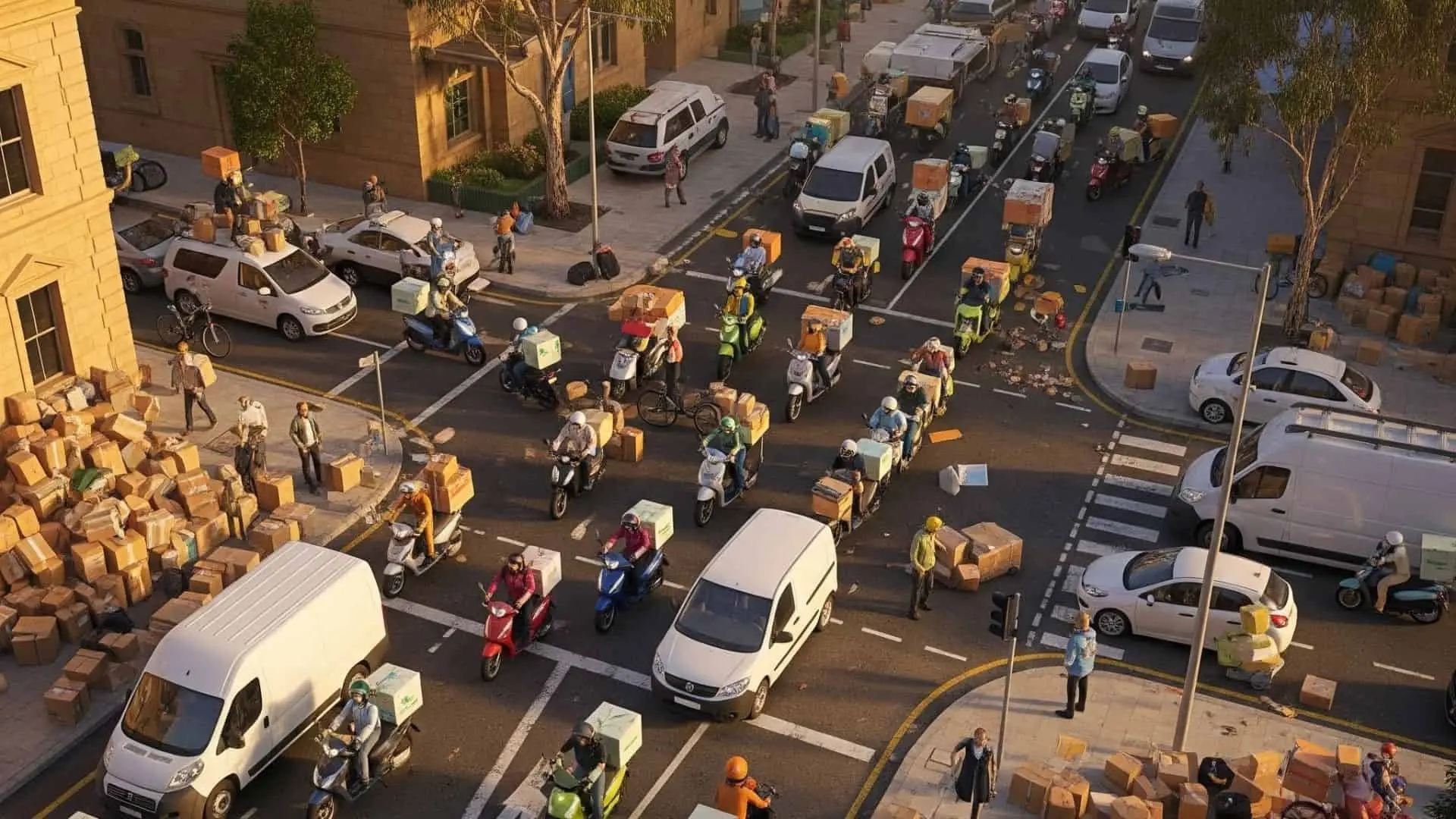
You've grown your delivery operation to 200 stops a day. That ought to feel like a milestone deserving celebrating.
Instead, your dispatchers are drowning, drivers are frustrated, and customers are calling to ask where their orders are.
Here's the hard truth: the route planning approach that got you to 200 deliveries is almost certainly the one that's now holding you back.
Manual methods, static software, and disjointed data don't just slow down at scale. They break. And when they break at 200+ stops per day, the fallout is felt across your entire operation.
The Breaking Point of Manual and Static Delivery Route Planning
It is easy to feel in control of route planning when you are juggling 30 or 50 deliveries; a dispatcher with a bit of local intuition can usually eyeball a sequence, account for the odd tricky time window, and get drivers on the road.
However, the underlying mathematics of logistics is working against you from the start, and it catches up remarkably fast. Once you hit 100+ stops across multiple vehicles, the sheer number of possible route combinations grows so explosively that it actually exceeds the number of atoms in the observable universe.
This is precisely why no human dispatcher, regardless of their experience, can truly "optimise" 200 deliveries by hand. The best a person can do is produce something passable, but in a high-volume operation, "passable" is just a polite way of saying your business is leaking money through every avoidable kilometre and missed efficiency.
Why Static Routing Hits a Wall with Courier Delivery
Basic route optimization software improves on manual planning, but many solutions share the same central limitation: they plan routes once at the start of the day using historical averages, then consider the job done.
This static approach ignores the reality that delivery operations are anything but static. Road closures, cancellations, same-day additions, and traffic incidents all happen after the plan is locked in.
Without the ability to recalculate on the fly, drivers are left to improvise, which leads to backtracking, overruns, and missed windows which spread across the rest of the schedule.
Real-Time Disruptions Amplify at Scale
In a high-volume delivery environment, a minor disruption is a systemic risk.
At 50 stops a day, a vehicle breakdown or a missed customer is a manageable hiccup, but once you scale beyond 200, these events produce a waterstream of downstream delays that a static plan simply cannot absorb.
Because the traditional route model lacks the elasticity to adjust on the fly, a single accident on the West Gate Freeway can effectively derail your entire afternoon schedule.
The Compounding Effect of Driver Fatigue
This rigidity itself creates a brutal feedback loop for your most valuable asset: your drivers. Poorly sequenced routes do more than just waste fuel; they induce premature fatigue.
When a driver is forced to spend their morning crisscrossing suburbs rather than following a logical, tight-knit sequence, their cognitive strain spikes.
A fatigued driver is far more prone to navigation errors, spends significantly longer at each drop-off, and is more likely to misread delivery instructions. This degradation in performance makes an already-flawed plan even worse in practice, directly eroding your service standards and safety margins.
Same-Day Inserts and Demand Surges
High-volume operations increasingly face pressure to accommodate same-day or next-hour delivery requests.
When a new order comes in mid-morning, a dispatcher using manual methods has to mentally re-sequence an already complex plan. In practice, they either tack the new stop onto the end of the nearest route (producing unnecessary kilometres) or slot it in where it seems to fit (without understanding the knock-on effect on every subsequent delivery).
Neither procedure preserves route efficiency or controls incremental cost. At 200+ deliveries, you might be absorbing dozens of these mid-day adjustments without realising how much they're eroding your margins.
Complex Constraints Overwhelm Human and Basic Systems
Scaling isn't just about more stops. Every additional delivery introduces its own set of constraints: a two-hour delivery window, a vehicle that needs a tail lift, a fragile item needing attentive handling, or a commercial customer who can only accept deliveries before 10am.
At small volumes, dispatchers hold these details in their heads or on sticky notes. At 200+ deliveries, the constraint set becomes unmanageable.
Spreadsheets can't dynamically balance time windows against vehicle capacities, driver hours, traffic predictions, and service-level agreements. The result is either over-padding (building in excessive spare time that reduces how many deliveries each driver can complete) or risky improvisation that leads to failed deliveries and broken promises.
Hidden Costs of Data Fragmentation
One of the less obvious reasons route optimization fails at scale has nothing to do with algorithms. It's about data living in too many places:
- Order details sit in a transport management system.
- Vehicle status and availability are tracked in a separate fleet app.
- Traffic conditions are monitored in yet another dashboard.
- Customer notes and special instructions live in a CRM or, worse, in someone's inbox.
When dispatchers have to manually stitch this information together, errors creep in. Addresses get mistyped, driver availability gets double-booked, and customer-specific instructions get lost between systems.
What Even Good Software Can't Fix on Its Own
Sophisticated route optimisation often fails when it ignores the 2026 operational ecosystem. Technology is not a silver bullet; its efficacy depends on three critical pillars: maintenance, communication, and human trust.
Relying on reactive fleet maintenance is a primary point of failure, as mid-route breakdowns can cost up to 4x more than scheduled service and instantly wreck even the most perfect AI-generated plan.
Furthermore, live communication is mandatory; without automated ETAs and instant dispatcher-to-driver links, execution buckles under the burden of unexpected variables.
Equally important is driver buy-in. In 2026, 18% of fleets prioritise technology adoption, yet many systems are undermined by drivers who distrust and override suggested routes. This strain frequently stems from over-constraining the system with rigid time windows that ignore real-world flow.
The highest-performing fleets treat optimisation as a holistic strategy that coordinates high-tech algorithms with preventive care and driver feedback. By dealing with these upstream issues, businesses are able to reduce fuel consumption by up to 23% and turn hypothetical efficiency into a measurable, long-term competitive advantage that actually sticks.
Common Failure Modes at 200+ Deliveries Per Day
To bring this together, here's a summary of where and how route optimization typically fails at high volume.
In 2026, manual planning hits a mathematical ceiling at high volumes, frequently resulting in 25% capacity loss due to the factorial complexity of possible routes.
Static plans fail when they cannot adapt to current traffic or order surges, leading to backtracking and missed windows.
Excessive constraints, such as rigid delivery slots, further choke the system's efficiency. When data is siloed across separate platforms, manual entry errors multiply.
Ultimately, even the best routes crumble without real-time visibility and driver accountability.
What True Scalability Actually Looks Like
Bad route optimization fails at 200+ deliveries because it treats routing as a one-time puzzle to solve each morning. Genuine scalability requires treating it as continuous, adaptive intelligence that runs throughout the day.
The Characteristics of Systems That Scale
Fleets that successfully grow beyond 200 daily deliveries without the operational chaos tend to share a few common traits.
First, they utilise dynamic re-optimization where routes adjust automatically as conditions change, whether that is a traffic incident, a cancellation, or a same-day order addition.
They also rely on integrated data, ensuring order information, vehicle telemetry, driver status, and purchaser preferences feed into a single platform rather than being stitched together manually.
Real-time visibility is a distinctive feature, allowing dispatchers and managers to see where every vehicle is and how each route is progressing so they can intervene before problems cascade.
These systems also prioritise driver accountability and input, providing optimised routes through a mobile app that captures proof of delivery and incorporates driver feedback to boost future planning.
Finally, they establish measurable baselines to quantify improvements in on-time rates, fuel consumption, and delivery density before making changes.
Growth Shouldn't Mean Growing Pains
Scaling from 200 to 500 or 1,000 deliveries per day doesn't have to mean proportionally scaling your headaches. But it does require acknowledging that the tools and processes that worked at lower volumes aren't designed for the complexity that comes with growth.
Pretending otherwise doesn't just stall progress. It actively costs you money, customer loyalty, and driver retention.
The fleets that scale successfully aren't the ones with the biggest budgets. They're the ones willing to honestly assess where their current approach falls short, pilot improvements inside regulated environments, and build operational capability alongside technological capability.
Frequently Asked Questions
Why does manual route planning fail at high delivery volumes?
The number of possible route combinations grows exponentially with each additional stop. Beyond 50-100 deliveries, no human can evaluate enough options to produce an efficient plan. The result is wasted kilometres, unbalanced driver workloads, and missed delivery windows.
What is the difference between static and dynamic route optimization?
Static optimization generates routes once, typically at the start of the day, and doesn't adjust them as conditions change. Dynamic optimization continuously recalculates routes in response to real-time events like traffic changes, cancellations, or new orders, keeping plans aligned with actual conditions on the road.
How much can poor route optimization cost a delivery operation?
Operations using manual or static methods at 200+ deliveries per day commonly experience 15-25% productivity losses. Failed first-attempt deliveries alone can cost $17 or more per package to reattempt, and fuel waste from inefficient routing can consume a significant portion of the delivery budget.
Can route optimization software work without fixing other operational issues?
Not effectively. Vehicle dependability, dispatcher-driver communication, driver training, and data quality all influence whether optimised routes translate into concrete results. The best outcomes come from treating route optimization as an element of a broader operational improvement strategy.
Ready to see how your delivery operation stacks up? Request access to explore how Locate2u can help you scale beyond 200 deliveries without the chaos.
Related Articles
Multi Stop Route Planning Across Australian Metros
In the fast-moving world of route optimization and delivery planning, multi stop route planning across australian metros has emerged as a defining factor...
How Can Route Optimization Save You From Chaos This Christmas
For delivery business owners grappling with inefficient routes, finding a practical, proven approach is essential. The landscape of route optimization and...
How Route Optimization Improves Sustainability Without Sacrificing Speed
For dispatch planners grappling with inefficient routes, finding a practical, proven approach is essential. The landscape of route optimization and...