Why Delivery Operations Break When Businesses Scale Too Fast
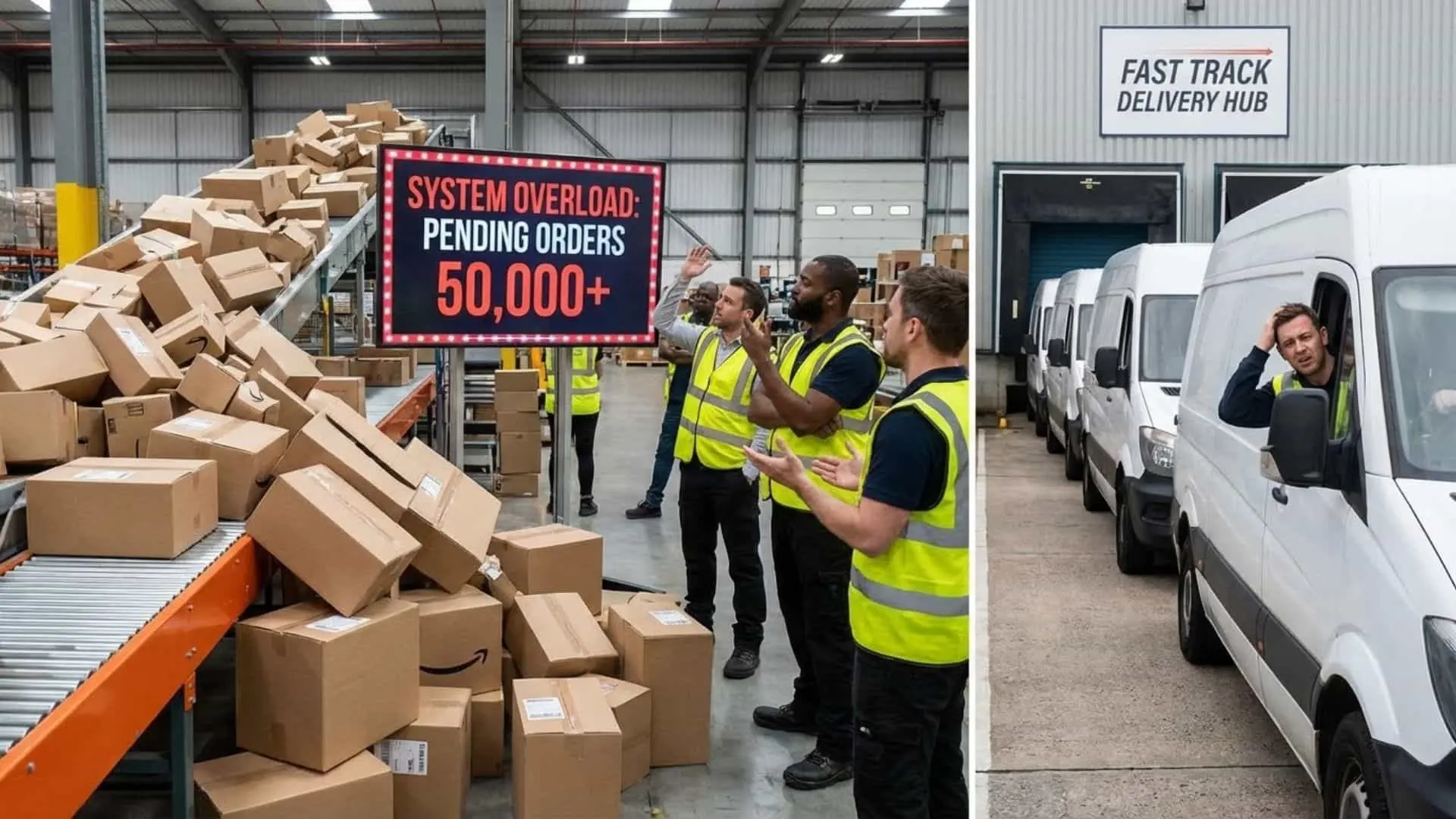
You've solved the delivery operations code. Orders are climbing, customers are coming back, and demand is pulling you into new suburbs, new cities, maybe even new states.
Growth feels great until your delivery operation starts buckling under the strain of it.
Here's the hard truth: the systems that got you to 100 deliveries a day will actively work against you at 1,000. Scaling delivery operations isn't a straight line.
It's a series of pressure points, and if you don't see them coming, what was once a finely tuned engine turns into constant chaos.
The Four Friction Points Where Delivery Operations Fall Apart
Do not assume that your specific delivery operations breakdown has not been seen before. In delivery logistics, mistakes are often found across the board.
They follow a predictable pattern, escalating from minor annoyances to full-blown systemic crises across four specific areas.
1. Inconsistent Delivery Performance
At low volumes, manual dispatching will usually work just fine.
The scenario is that a dispatcher who knows the drivers and the usual trouble spots can keep operations flowing with little more than a spreadsheet and a phone.
But as volumes spike in 2026, variability inevitably crops up and unfortunately creeps in through traffic delays, last-minute cancellations, and overlapping time windows.
Note that the problem is not that your team got worse; it is simply that the operational complexity outgrew the tools they were given.
2. Fragmented Delivery Visibility and Tracking
Growth almost always requires adding more delivery providers.
You might have an in-house fleet for metro areas, a regional partner for outer suburbs, and an on-demand courier for same-day orders.
Each provider has its own tracking system, its own event data format, and its own definition of what "out for delivery" actually means.
The result is that managers lose real-time oversight and ETAs begin to drift unpredictably.
Customers receive vague notifications that diminish their trust in your brand. And the only way issues ever get surfaced is when a frustrated customer calls in to ask where their order is.
3. Reactive Exception Handling
Every delivery operation deals with exceptions like failed attempts, damaged goods, or wrong addresses.
At a small scale, these are minor inconveniences handled with a quick phone call or a manual refund.
At scale, they become a firehose of problems.
Each exception demands personal intervention, whether that means rebooking a delivery, issuing a credit, or dispatching a replacement.
Support tickets multiply while costs balloon. And your team spends more time putting out fires than preventing them from starting.
4. Escalating Costs and Staffing Strain
The instinctive response to delivery pressure is to throw more bodies at the problem.
You hire more drivers, add another van, or extend shifts.
But without the right infrastructure, increasing headcount alone does not solve the issue; it just makes it more expensive.
In-house fleets face driver turnover, overtime creep, and rising maintenance costs, while multi-provider setups add coordination costs without proportional gains.
Last-mile delivery already accounts for roughly 53% of total shipping costs for many Australian businesses in 2026. Scaling without proper optimisation only serves to inflate that number.
How Breakdown Stages Escalate with Growth
These friction points do not hit all at once. They worsen in predictable phases, and recognising exactly which stage you are in allows you to act before the operation spirals.
In Early Growth, your volumes might double, but those manual processes still mostly hold together. Outcomes are uneven because dispatching is purely ad-hoc, but nothing feels fundamentally broken yet.
By Mid-Scale, you are adding new regions or delivery providers, and significant visibility gaps start to appear. The team shifts into a permanent reactive mode, firefighting daily problems instead of improving the actual systems.
At Hyper-Scale, exceptions multiply much faster than your old rules can handle. Despite healthy demand, the operation exists in a state of constant crisis, and costs inflate even as revenue grows.
The dangerous part about this progression is that each stage feels like it can be muscled through. It is tempting to believe that the next hire or the next provider will finally fix things. But without structural changes, you are just adding fuel to a fire.
Why Complexity Grows Faster Than You Think
This is the bit that catches most growing businesses off guard: delivery complexity doesn't scale linearly with order volume. It scales exponentially.
At 100 deliveries a day, you're managing a relatively small set of variables. Store readiness, driver availability, a handful of routes, maybe one or two delivery windows.
At 1,000 deliveries a day, those variables multiply and interact in ways that manual processes simply can't keep up with.
Dispatch Decisions Depend on Who's Working
When dispatching relies on a person's memory of drivers, routes, and client choices, service quality fluctuates with every shift change.
One dispatcher might prioritise speed; another might prioritise geographic clustering. Neither approach is consistently optimal, and the lack of standardisation creates invisible service gaps.
Workflows That Scaled Once Can't Handle New Channels
A routing process designed for a single warehouse and a local delivery zone breaks when you add a second fulfilment centre, a marketplace integration, or a click-and-collect option.
Each new channel introduces exceptions that the first workflow was never built to handle.
No Feedback Loops Means No Learning
Without up-to-date data capture and analysis, operations teams are effectively flying blind.
They can see that deliveries are late, but they can't pinpoint whether it's a routing issue, a loading delay, or a driver performance problem. This leads to endless tweaking without real improvement.
Provider Proliferation Fragments the Customer Experience
Every additional delivery partner introduces "it depends" scenarios. The customer doesn't care whether their order is being handled by your in-house fleet or a third-party courier.
They just want it on time with clear communication. But when every provider operates differently, consistency becomes nearly impossible to maintain.
Across sectors like food delivery and e-commerce, poor demand forecasting and inventory mismanagement add a further level of difficulty, risking product waste alongside delivery delays.
The Real-World Traps That Catch Expanding Businesses
It is worth noting that this is not a problem unique to small businesses punching above their weight.
Enterprises scaling last-mile delivery frequently stall because legacy processes simply cannot keep pace with 2026 market expectations.
Funnily enough it's often the startups that built digital-first delivery infrastructure that can iterate faster than established players still relying on systems designed for a separate era.
Some of the most common traps include:
Over-investing in headcount without orchestration means you are paying more for the same, or worse, outcomes by adding drivers without optimising their dispatch or tracking.
Assuming what worked locally will work regionally is a mistake because delivery dynamics change considerably across geographies as traffic patterns, customer density, and provider availability shift.
Many businesses treat delivery tech as a "nice to have" until they are already in crisis, which results in a rushed implementation and rocky adoption.
Delayed deliveries, rework, and customer churn are real costs, but they are often hidden in operational noise until someone finally does the maths.
Building Resilient Delivery Operations That Feed Into Same-Day Delivery Services
The good news is that delivery breakdowns during scaling are not inevitable.
They are predictable, which means they are preventable, provided you invest in the right foundations before the cracks appear.
Centralise Your Delivery Workflows
Whether you are running an in-house fleet, working with third-party providers, or managing a hybrid setup, you need a single source of truth for dispatch, tracking, and performance data.
Centralisation eliminates the visibility gaps that come with stitching together multiple systems.
A platform like Locate2u brings route optimisation, instant tracking, and proof of delivery into one place, giving dispatchers and managers a unified view of every delivery, regardless of who is making it.
Build Data-Driven Feedback Loops Alongside Your Courier Service
You cannot improve what you do not measure, and you cannot measure what you do not capture.
Tracking key metrics, particularly on-time delivery rates, average route efficiency, and client happiness scores gives your team the insight to iterate weekly rather than guess quarterly.
Features like auto-dispatch and performance dashboards turn raw delivery data into useful intelligence, helping operations teams fix root causes instead of chasing symptoms.
Invest in a Tech Stack That Scales With You
The right technology should not just solve today's problems; it should accommodate tomorrow's complexity.
That means multi-carrier visibility, flexible routing algorithms, a driver app that works across your entire fleet, and real-time controls which adapt as conditions change.
Businesses that invest in scalable delivery infrastructure early report measurable results, including up to 20% higher delivery conversion rates and 50% fewer inbound support calls.
Delivery stops being a cost centre and becomes a genuine competitive advantage.
Scale Deliberately, Not Desperately
Growth is exciting. But growth without operational capability is a recipe for the kind of delivery failures that damage buyer trust and eat into margins.
The businesses that scale successfully aren't the ones that react fastest when things break. They're the ones that build infrastructure before it's urgently needed.
Match your delivery infrastructure to your ambition. Centralise your workflows, automate recovery, track what matters, and invest in technology that grows with you.
That's the difference between scaling up and falling apart.
Frequently Asked Questions
Why do delivery operations fail due to rapid business growth?
Delivery operations fail in rapid scaling because complexity grows exponentially with order volume. Manual processes, fragmented tracking systems, and reactive exception handling that work at low volumes become unsustainable as deliveries multiply. Without centralised systems and automation, teams spend more time firefighting than delivering.
What are the biggest cost drivers in last-mile and same-day delivery?
Last-mile delivery can account for over 40% of total supply chain costs, a big chunk off your delivery network. The biggest drivers include failed delivery attempts requiring redelivery, inefficient routing, driver overtime, and the coordination burden of managing multiple delivery providers without unified systems.
How can route optimisation help with scaling delivery operations?
Route optimisation uses algorithms to calculate the most efficient delivery sequences, accounting for aspects such as traffic, time windows, vehicle capacity, and driver availability. As volumes grow, optimised routing prevents the exponential increase in fuel costs, drive time, and missed ETAs that manual route planning creates.
When should a business invest in delivery management technology?
The best time to invest is before operations are in crisis. Businesses that implement delivery management platforms during their early growth phase avoid the costly breakdowns that come with mid-scale and hyper-scale complexity. Retrofitting technology during a crisis is far more disruptive and expensive.
Not sure where your delivery operations stand? Book a free operations review with our logistics experts to uncover quick wins for your fleet.
Related Articles

Why Dense Cities and Rural Routes Need New Last-Mile Delivery Strategies
If you manage last mile deliveries across both metro areas and regional zones, you already know the frustration: what works brilliantly in Sydney's inner west completely falls apart on a run through outback Queensland...
The Operational Trade-Offs Behind Same-Day Delivery
Same-day delivery is an absolute essential for most companies. But here's what rarely makes it into the marketing copy: delivering on that promise involves a web of operational trade-offs that can make or break your margins, your fleet, and your customer relationships...

The Real Math Behind Multi-Vehicle Route Planning
If you manage a fleet of more than a handful of vehicles, you've probably had this thought: "There has to be a smarter way to plan all these routes." You're right. And the math behind it is fascinating...