Courier Management Software That Protects Your Margin and Your Records
Drafted with AI assistance, edited and fact-checked by Sean Flannery. See our editorial policy.
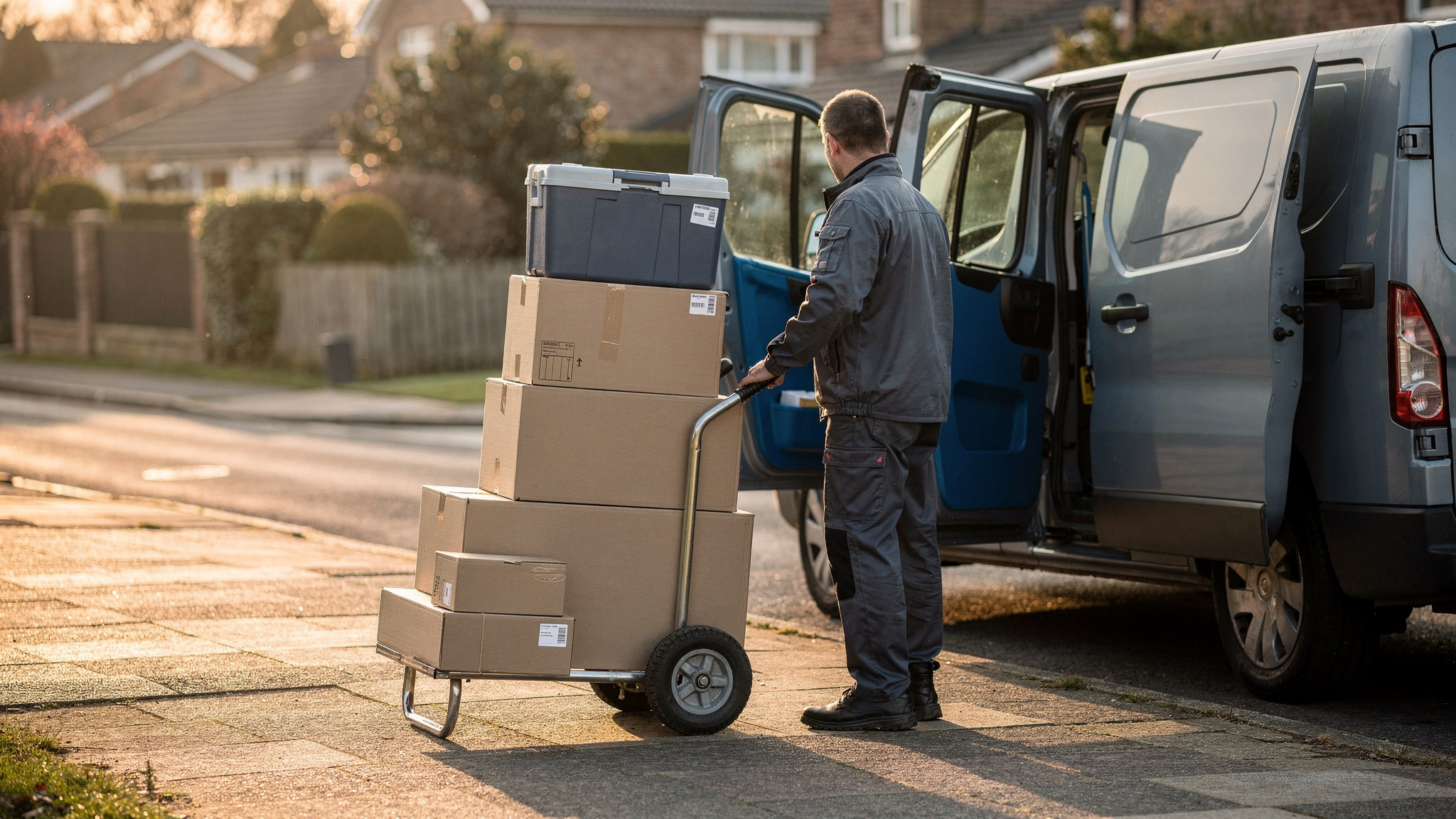
Courier management software runs the daily work of a courier operation in one system: taking orders, dispatching drivers, optimising routes, tracking vehicles live, capturing proof of delivery and keeping driver records. It matters because last-mile delivery makes up 41% of total logistics supply chain costs, according to Capgemini, so small routing and dispatch gains show up directly in margin.
One caveat on that number. Capgemini's page was published in February 2025, but the figure comes from earlier Capgemini Research Institute work, so treat it as dated. It's a strong direction of travel, not a live reading.
Margin is only half the job. The other half is records: who delivered what, where and when, and which driver or subcontractor did it. Those records win customer disputes, as Perth Couriers found with refrigerated freight, and more and more they're what a regulator or a large client asks to see.
Courier management software earns its keep in the last mile, where the costs pile up
The last mile is the stretch where a parcel leaves the depot and meets a real doorstep. It's where stops multiply, and every stop is another small chance for something to go wrong.
Capgemini's analysis lists what the last mile asks of your technology: order handling, sorting, route optimisation, cost optimisation, capacity planning, real-time ETA estimation, payment processing, returns processing, labelling and customer service. Most small and mid-size couriers cover that list with a patchwork.
Orders arrive by email and a web form, and someone copies them into a spreadsheet. Routes get planned on a consumer map app. Drivers ring the office when an address is wrong, and paper dockets come back at the end of the shift, if they come back at all.
Each tool works fine on its own. The cost hides in the gaps between them, where a person retypes an address, a time window or a signature.
So the real job of courier management software isn't to add another screen. It's to close those gaps, so an order entered once flows through dispatch, the route, the driver's phone and the delivery record without anyone keying it again.
Dispatch is usually where the gap hurts most, because it happens under time pressure. Our guide to choosing dispatch management software walks through that piece on its own.
Parcel volumes keep climbing in every major market, and spreadsheets are the first thing to break
Parcel growth isn't a single-country story. The Pitney Bowes Parcel Shipping Index puts US parcel volume at 23.1 billion shipments in 2025, up 3.3% on the year.
In Europe, a European Labour Authority study published in June 2025 cites the ERGP report, built from national postal regulators' data, showing parcel volumes delivered in Europe rose 12.1% between 2019 and 2022. UK regulator Ofcom measured 4.2 billion parcel items in the 2024-25 financial year, up 7.1%.
Those are different measures over different periods, so they don't add up to one global number. What they share is the direction, and for a courier that direction becomes a practical question: can you take on more work without the office growing at the same rate?
Eurostat reports that 77% of EU internet users bought goods or services online in 2024, up from 59% in 2014, which means more of your stops are homes where nobody may be in to sign, and that's exactly where disputes start.
Spreadsheets are the first thing to break under that load. Not because they're bad tools, but because they need a person to move every order and record every outcome by hand.
Perth Couriers shows where the pressure lands. It's a courier service in Perth, Australia, delivering temperature-sensitive goods: refrigerated products, health foods, fresh fruit and vegetables, and dairy.
Perishable freight makes every disagreement expensive, and trust matters more than usual. Like most refrigerated couriers, the team fielded claims that a delivery was late, incomplete or mishandled, and had limited evidence to settle them quickly.
They adopted Locate2u's proof of delivery and route optimisation platform. Every delivery now carries photo documentation, timestamps and location data, routes follow the most efficient paths so perishables spend less time in transit, and automated notifications tell recipients when to expect their order.
In the team's own words: "Our customers trust us more than ever, and disputes have been cut back significantly." Their case study doesn't put a number on that drop, so we won't either.
Look at what changed. The cargo didn't. What changed is that every delivery now produces its own record, instead of relying on someone to reconstruct it afterwards.
If your work is mostly parcels at volume rather than scheduled runs, our piece on parcel delivery management software covers that side in more depth.
Fuel and route sequencing decide your margin more than your rate card does
Most couriers spend a lot of energy on pricing. Rate cards get reviewed, fuel levies get argued over and big accounts get special rates.
But the European Labour Authority names two forces behind margin pressure in parcel delivery: rising fuel costs and increased competition. Competition caps what you can charge. Fuel is a cost you can actually work on, and the same study says it can contribute up to around 25% of total last-mile delivery expenditure.
That's why route sequencing matters more than most people expect. Every extra kilometre or mile is fuel you've already paid for and driver time you can't bill.
The sequence that wins is rarely the shortest line on a map. It's the one that respects time windows, vehicle capacity and the urgent job that lands mid-morning. That last part is where static planning falls down, because a route built before the first van leaves is out of date the moment one order changes.
SuperPharmacy, an Australian online pharmacy delivering prescriptions to customers nationwide, hit exactly that wall. Its delivery team spent up to one hour every day planning routes by hand, and when an urgent prescription came in during the day, the whole route had to be regenerated from scratch.
With Locate2u's routing, that planning now takes 10 minutes, which the SuperPharmacy case study describes as an 83% cut. New prescriptions slot into live routes without disturbing other deliveries, and that flexibility is what let them offer same-day prescription delivery as a core service.
As the team put it: "Before Locate2u, we had to generate new routes if we wanted to change anything. Now we can adjust the day's deliveries on the fly." A pharmacy isn't a courier, but any dispatcher juggling mid-morning jobs will recognise the problem.
The World Economic Forum made a similar point back in January 2020. Its last-mile ecosystem analysis estimated that e-commerce demand would put 36% more delivery vehicles in inner cities by 2030 without intervention.
Among the fixes it listed was dynamic rerouting: constant route updates that reduce mileage and the time drivers need to deliver. The projection is dated. The logic hasn't aged at all.
This is the core of Locate2u's route optimisation. Sequence the day around real constraints, then adjust live when orders change, instead of rebuilding the whole plan from scratch.
Proof of delivery settles arguments before they reach your inbox
Every courier knows the usual disputes. It didn't arrive, it arrived damaged, it arrived late. Without evidence, each one becomes your driver's memory against the customer's, and the quickest way out is a credit or a redelivery, whoever was right.
Proof of delivery changes the conversation. At each stop, the driver captures a photo, a signature where one's needed, a timestamp and the GPS location, and that record attaches to the job where the office, and the customer if you choose, can see it straight away.
Now the question isn't who remembers better. It's what the photo shows, which is the shift Perth Couriers made with its refrigerated deliveries.
Live tracking does the other half of the work, earlier. When a recipient has a link showing where the driver is, they can plan to be there, and the where-is-it calls ease off.
A few habits make the evidence stronger:
- Photograph the goods in place, with the door or unit number in frame where you can.
- Make a photo mandatory for the job types that generate disputes, such as unattended drops.
- Record damaged packaging at handover, before the driver leaves the stop.
- Keep the record easy to share, so the office can answer a complaint in one reply.
It helps billing too. A stop with a photo and a timestamp is a stop you can invoice without a follow-up phone call.
Driver and subcontractor records are turning into compliance evidence, not just admin
This is the part of courier software that buyers skip. I'm Sean Flannery, Enterprise Logistics Specialist at Locate2u, and it's the part I'd push hardest on.
Working with courier and dispatch teams, the pattern I see is that driver records rarely feel urgent. Licences sit in a folder and contractor details live in a spreadsheet. The delivery app knows who did which stop, but nobody joins the three up.
Then someone asks a question. A large client wants to know who handled its goods on a particular day, an insurer wants to know which driver was on a route, or an inspector wants to see who was working, and for whom. The answer exists somewhere, but it takes a day of digging to find.
In the EU, this scrutiny is already concrete. The European Labour Authority's 2025 study of parcel delivery focuses on bogus self-employment, under-reported working hours and subcontracted service partners, and each of those maps to a record your platform should hold.
For bogus self-employment, that's who each driver actually works for, captured at onboarding. For working hours, it's a timestamped trail of every stop. For service partners, it's which subcontractor completed which job. The study doesn't set your obligations, so check the current requirements with your national labour and transport regulators wherever you operate.
Good software gives you the raw material. Every driver, employed or subcontracted, has their own login, so every stop belongs to a named person, and every completed job carries a timestamp and a location you can pull up by driver or by subcontractor.
Be honest about its limits. A delivery log isn't automatically a statutory working-time record, and it won't replace employment paperwork. But it's consistent evidence, and consistent evidence is what makes the rest of your records believable.
The mistake I see most is onboarding subcontractors outside the system to save a bit of time. Their work then sits in a blind spot, which is exactly where the hard questions tend to land.
A courier platform that only talks to one carrier is already behind
Work doesn't arrive from one place any more, and it doesn't always leave in your own vans either. In the UK, Ofcom names Evri, DHL, Yodel and DPD among the operators competing with Royal Mail, mainly for business-to-consumer parcels. In the EU, the European Labour Authority's study describes delivery networks built on subcontracted service partners.
Orders come from more channels and parcels change hands more often. A platform that only talks to one store or one carrier pushes someone straight back into retyping.
Locate2u connects to Shopify for order intake, and other order systems connect through the public API and integrations. Whatever you evaluate, ask to see a live connection, not a logo on a slide.
The short checklist that separates real courier software from a map with a login
Plenty of products call themselves courier software, and some are a map with a login. You can tell them apart in a single walkthrough.
Before any demo, measure your own starting point, because platform-wide averages won't tell you much about your operation. For two weeks, log how long route planning takes each day, how often a route gets rebuilt after the vans leave, and how many delivery disputes reach the office. Then you have something real to compare against.
Bring a real day of your own orders, not the vendor's sample data. Then ask to see each of these working:
| What to check | Ask to see it working | Why it matters |
|---|---|---|
| Order intake | Orders from your store or API landing in the plan with no retyping | Retyping is where addresses and time windows go wrong |
| Route optimisation and re-planning | A live route re-sequenced when an urgent job arrives mid-morning | Sequencing drives fuel spend and driver time |
| Driver app | A driver completing a stop on a phone in a few taps | If drivers avoid the app, the data never arrives |
| Proof of delivery | Photo, signature, timestamp and location on a finished stop | Evidence settles disputes in one reply |
| Live customer tracking | The exact link a recipient receives | Fewer where-is-my-parcel calls to the office |
| Driver and subcontractor records | Last month's activity for one driver or subcontractor, found fast | Clients, insurers and inspectors ask these questions |
| Integrations | Public API documentation and a live connector | Work arrives and leaves through many systems |
If a platform stumbles on re-planning a live route, or on finding one driver's delivery history, you've learnt what you needed to know.
Frequently asked questions
What is the difference between courier management software and a transportation management system?
A transportation management system is built for freight: planning linehaul loads, tendering to carriers and auditing freight invoices. Courier management software is built for many short local stops a day, with a driver app, live customer tracking and proof of delivery at every door.
Is courier management software worth it for a courier with only a few drivers?
Usually yes, because the owner is often the one planning routes and answering where-is-my-parcel calls at night, and that time comes back first. Locate2u prices per user, so a small courier pays for the drivers it runs and grows on the same platform; see the Locate2u pricing page for current tiers.
Can courier management software pull orders straight from an online store like Shopify?
Yes. Locate2u connects to Shopify so orders, chosen delivery dates and time windows flow straight into route planning without retyping, and other order systems connect through the public API.
What legally counts as a courier business rather than a postal service?
The US Bureau of Labor Statistics defines couriers and messengers as intercity or local delivery of parcels and documents, including express, without a universal service obligation. In plain terms, couriers choose where and what they deliver, while national postal operators must serve every address.
Where these numbers come from. Every figure above traces to a named, dated source:
- Capgemini expert perspective on last-mile deliveries, February 2025, for the last-mile cost share and the list of last-mile technology needs. The cost share comes from earlier Capgemini Research Institute work, so treat it as dated.
- European Labour Authority study on parcel delivery, June 2025, for the fuel cost share and the margin pressures behind it, for European parcel growth, which the study draws from the ERGP report, and for its findings on self-employment, working hours and subcontracting.
- Pitney Bowes Parcel Shipping Index, 2026 edition covering 2025, for US parcel volume.
- Ofcom postal services monitoring report for the 2024-25 financial year, published December 2025, for UK parcel volumes and the operators competing with Royal Mail.
- Eurostat, February 2025, for online buying across the EU.
- World Economic Forum, January 2020, for the inner-city delivery vehicle projection and dynamic rerouting. This one is dated.
- The US Bureau of Labor Statistics industry definition, and the Locate2u Perth Couriers and SuperPharmacy case studies.
If you're choosing courier management software this year, start where the money and the arguments are. Get route sequencing and live re-planning right to protect your margin, and make proof of delivery non-negotiable to protect your records. Then run a real day of your own orders through Locate2u's proof of delivery and routing tools and judge the result on your data, not ours.