How to Start a Pharmacy Delivery Service That Reaches Patients First Time
Drafted with AI assistance, edited and fact-checked by Sean Flannery. See our editorial policy.
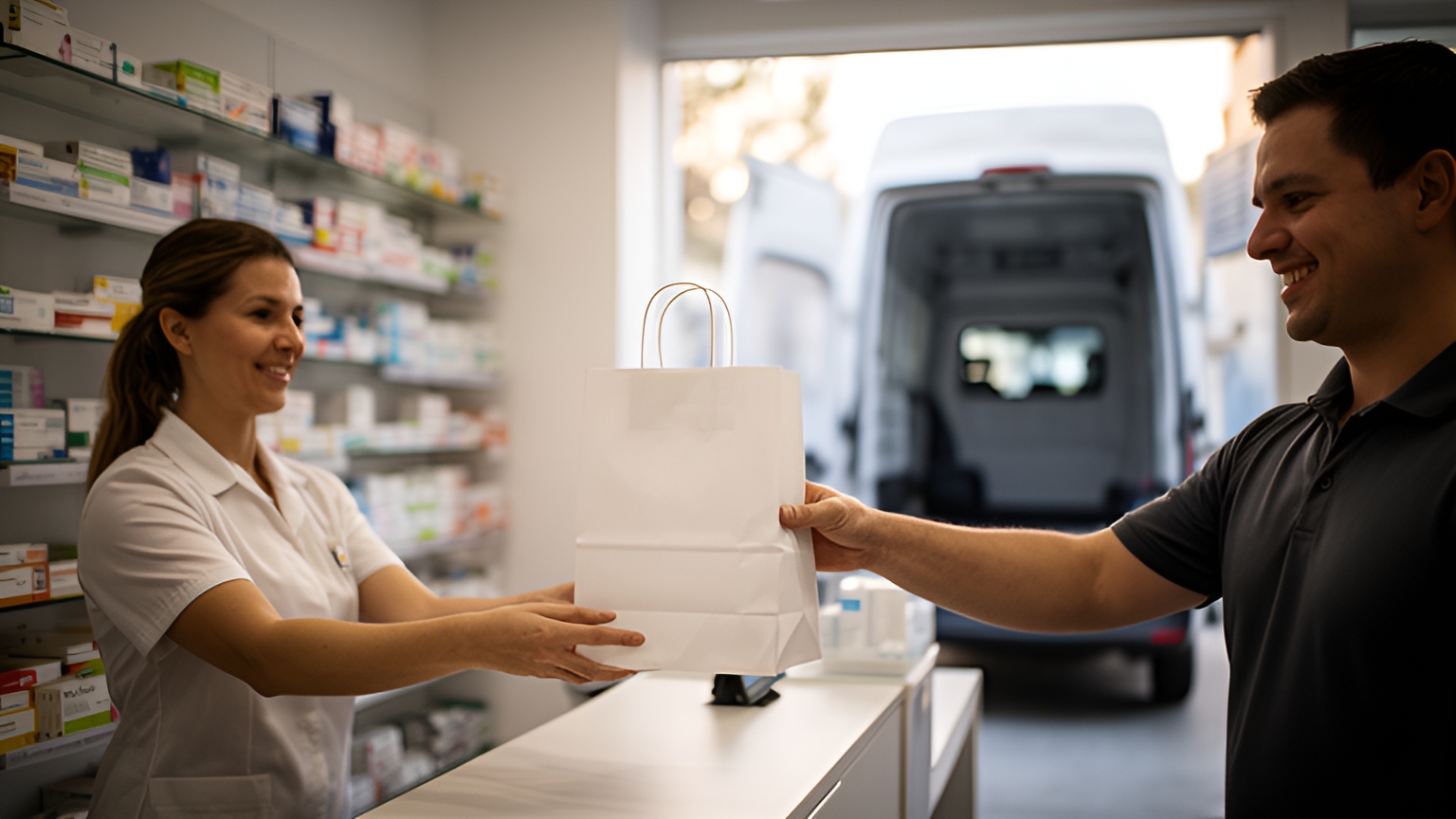
To start a pharmacy delivery service, set a daily dispensing cut-off, launch in a compact zone, route cold and time-critical medicines first, plan how missed deliveries return to the pharmacy and go back out, and give patients live ETAs with proof of delivery. Route optimisation software keeps those steps running as order volume grows.
Each step serves the same outcome. The right person receives the right medicine on the first visit, inside the window they were promised.
Starting a pharmacy delivery service around first-visit success
A parcel that misses its first attempt can usually wait a day. A prescription is different. It is dispensed for a named patient and is often needed that day, and some items have to stay cold.
That makes first-visit success the measure to design around from the start.
Parcel networks show how much room there is to improve. A 2023 Harvard Business Review research article reports that up to 20% of e-commerce packages aren't delivered on the first attempt.
For a pharmacy, an attempt that does not complete means a bag travelling back to the dispensary, a fridge check for cold items and a second trip. Designing the service to avoid that loop keeps drivers' time on new deliveries.
The same research points to fixes that cost little. In parcel delivery research reported by Harvard Business Review, low-cost changes, including putting the riskiest stops earlier in the route, lighter truck loads and driver schedules, and smaller delivery zones, can reduce failed delivery attempts by up to 10%.
Those findings come from parcel networks, not pharmacies. But each one maps onto a decision a new pharmacy service makes in its first week: how big the zone is, which stops go first, and how full each driver's day becomes. The sections below turn each lever into a pharmacy step.
Australian online pharmacy SuperPharmacy, whose story closes this guide, shows what flexible routing makes possible for same-day prescriptions.
If the service is already running and the goal is speed, the guide on how to deliver medicines to patients fast covers that side in more depth.
How to set dispensary cut-offs so prescriptions leave ready to deliver
A delivery run is only as ready as the bags waiting at the dispensary door.
A dispensing cut-off sets that rhythm. Prescriptions received before the cut-off are checked, bagged and placed on the next run. Anything after it joins the following run, and the patient hears which one when they order.
Work backwards from the departure time. If the first run leaves after lunch, place the cut-off far enough ahead that the pharmacist can finish final checks at a comfortable pace.
Patients judge a delivery service first on whether the bag holds exactly the medicines they ordered. So the readiness check matters as much as the route itself.
A bag is ready to route when it has:
- the pharmacist's final check completed against the order
- the patient's name, delivery address and contact number on the label
- a clear flag on anything that must stay refrigerated
- access notes, such as a gate code or a preferred door
- the delivery window the patient chose
Batch bags by run, not by the order they were dispensed. A shelf or crate per run lets the driver load in route order, while cold items wait on a dedicated fridge shelf until the last moment.
The same details should flow into route planning without retyping. When addresses, windows and notes arrive complete, the plan reflects what the driver will find at each door.
Review the cut-off after the first fortnight. If prescriptions often arrive just after it, a second, later run may serve patients better than moving the cut-off and shortening checking time.
How a compact launch zone keeps every run on time
A small zone is the simplest way to keep every run on time while the team learns the routine.
Draw the first zone so a driver can complete a full loop and be back at the pharmacy inside the delivery window. Smaller zones are one of the parcel-research levers above, and a tight loop also leaves room for a same-day re-attempt when a patient is out.
Start where demand already exists. Repeat-prescription patients who collect in person are a natural first audience, and mapping where they live shows where the first zone should sit.
Make ordering easy for every age group. Eurostat reports that in 2025 the share of people aged 65 to 74 buying online in the EU was 55%, below the EU average.
So take delivery orders by phone and at the counter as well as online, and feed all of them into the same delivery list.
Define the zone by postcode or ZIP code. Counter staff and phone staff can then tell a patient straight away whether delivery is available at their address.
Offer one or two delivery windows to begin with. Fewer windows mean denser runs, and each promised window becomes easier to keep.
Expand one neighbouring area at a time, once the on-time and first-attempt measures hold steady. Growth that keeps the zone dense keeps the promise to patients.
How to sequence stops so cold and time-critical medicines go first
Route order decides which medicines spend the longest in the vehicle. On a pharmacy run, that order follows the medicine as well as the map.
Cold items go first. Room-temperature stability differs from one refrigerated medicine to the next, so the pharmacist's guidance, not the map, sets the order for them.
Ask the supervising pharmacist which products need cold handling and how long each can safely spend out of the fridge, then plan the run so those stops come early. Load them last so they are the first bags the driver reaches.
Time-critical stops come next. Think of a patient starting a new course today, or someone home from hospital who needs a dose before evening.
Then the stops most likely to need a second try. Placing the riskiest stops earlier is another of the parcel-research levers from the first section, and it translates directly to pharmacy runs.
For a pharmacy, a higher-risk stop can be a first-time address, a building with an access code or a patient with a narrow window. Reaching them early leaves time in the day to try again.
| Stop type | Route position | Reason |
|---|---|---|
| Cold items | First, loaded last | Least time out of the fridge |
| Time-critical medicines | Early, inside their window | The patient needs a dose today |
| First-time or access-code addresses | Early in the run | Time remains for a same-day second try |
| Repeat prescriptions, wide window | Later in the run | The patient expects them across a longer window |
Locate2u route optimisation plans multi-drop routes with delivery windows. Giving cold and urgent stops tighter windows is a practical way to bring them forward without reordering every stop by hand.
How to plan driver hours as repeat prescriptions grow
Repeat prescriptions are the steadiest demand a pharmacy delivery service has. The same patients need the same medicines on a predictable cycle, so their deliveries can be planned weeks ahead.
Turn them into standing runs. Give each repeat patient a regular day and window, and let new or one-off orders fill in around that base load.
Then plan hours with slack. Lighter driver schedules are the remaining parcel-research lever, and they give a driver room to wait at the door a little longer, call a patient, or fit in a re-attempt on the way back.
A wage benchmark helps weigh what that slack costs. The US Bureau of Labor Statistics reports a mean hourly wage of $18.44 for couriers and messengers in May 2023.
Here is a worked example on assumed inputs: a four-hour run paid at that mean wage of $18.44 an hour, planned first at twenty stops and then at eighteen, with two slots held back for re-attempts.
The run's wage cost is the same in both plans: four hours at the mean wage. Shared across eighteen stops instead of twenty, each planned stop carries one-ninth more of that cost.
What the two spare slots buy is time to finish today's re-attempts, rather than sending those bags out again on tomorrow's run.
The sum counts the mean wage only, not vehicle running or other employment costs. Outside the US, swap in a local wage benchmark and run the same steps.
The same per-stop view gives a starting point for a delivery fee. Decide whether the fee covers that cost, part of it, or none of it for standing repeat runs, and whether a free-delivery threshold, such as a minimum order value, suits the pharmacy's patients.
Whatever the choice, show the fee before the patient orders, and quote it the same way at the counter, on the phone and online.
Next, decide who drives. Standing repeat runs suit in-house drivers who come to know the zone. Peaks and same-day overflow can go to an on-demand courier, so the core team's hours stay steady.
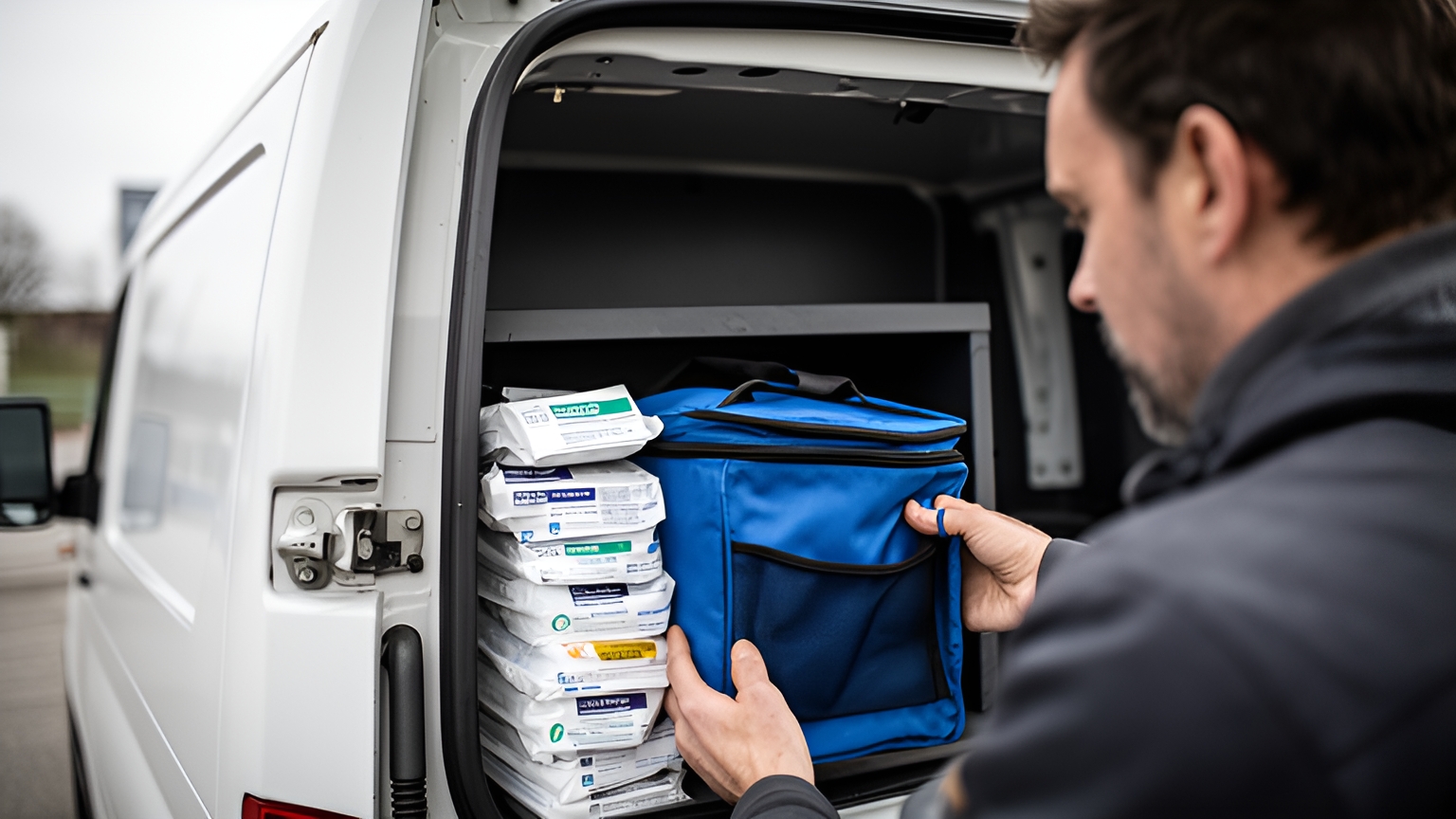
Whichever drivers run the service, check each vehicle before launch: space to keep cold carriers apart from room-temperature bags, a secure place for bags between stops, and a phone mount for navigation and proof of delivery.
As volume grows, add a second run before adding a second zone. Keeping drivers inside a dense area protects the first-visit rate the service was built on.
How to bring a missed delivery back and send it out again
Even a well-planned run will meet a patient who is out. A clear return loop turns that moment into a short delay.
Agree the handover rules with the supervising pharmacist before launch: who may receive a delivery, such as the patient or an authorised carer, and whether any item can be left without a handover. A simple default is that prescription bags go to a person, not a doorstep.
Requirements for controlled or restricted medicines and for patient privacy differ between markets. Before the first run, the supervising pharmacist confirms the current local requirements for each item type the service will carry.
At the door, the driver records the attempt time and the reason, then tries the patient's contact number. Sometimes a quick call is all it takes for the patient to come down from upstairs.
If the stop still can't be completed, the bag comes back to the pharmacy the same day. Cold items go straight back into the fridge, and the pharmacist checks the bag before it is offered again.
Then rebook. Contact the patient, agree a new window and add the bag to the next run, or to a same-day re-attempt if the zone and the driver's slack allow it.
Keep a log of reasons. Several attempts at one building may point to an access note worth adding, while a pattern in one window may show that another window suits those patients better.
How live ETAs and proof of delivery give patients confidence
Patients plan their day around a delivery. A clear arrival time helps them be home, and helps a carer be there when the patient can't.
Timing is what online shoppers notice most. Among EU online shoppers, Eurostat reports that "speed delivery slower than expected" was the most often reported issue, declared by 20% of individuals.
That points to a simple design choice: show the patient the arrival time as it moves, rather than a fixed window alone.
Locate2u real-time tracking lets the pharmacy share a live tracking link with each patient, so they can see the driver approaching and be ready at the door.
Send the link when the run departs. A patient who can see the driver a few stops away has time to get to the door, which supports the first-visit goal.
The pharmacy team benefits too. When a patient calls to ask about their medicine, the answer is on screen.
Proof of delivery closes the loop. Locate2u proof of delivery captures photo evidence, signatures and timestamps for every delivery, giving the pharmacy a clear record of each handover.
For prescriptions, ask drivers to collect a signature from the patient or the authorised carer agreed with the pharmacist. Pharmacy staff can then confirm exactly when each bag reached its patient.
How an online pharmacy made same-day prescription delivery a core service
SuperPharmacy's case study reports that the online pharmacy cut route planning time by 83%, with daily planning that took up to one hour now taking just 10 minutes, one Australian business's result.
SuperPharmacy has operated as an online pharmacy in Australia since 2000. It serves customers nationwide, delivering prescription medications, over-the-counter products and health essentials to the door.
As demand for faster delivery grew, prescription routes were still planned by hand. When a new urgent prescription arrived during the day, or a delivery needed rescheduling, the route had to be regenerated from scratch.
With Locate2u route optimisation, routes are generated automatically from delivery locations, time windows and driver availability.
The bigger change came during the day. New prescriptions can be slotted into existing routes on the fly, without disrupting other deliveries.
That flexibility enabled SuperPharmacy to offer same-day prescription delivery as a core service. In SuperPharmacy's words: "Before Locate2u, we had to generate new routes if we wanted to change anything. Now we can adjust the day's deliveries on the fly."
This connects straight back to the cut-off. A service that can absorb a late urgent prescription can keep its cut-off comfortable for the pharmacist and still say yes to the patient.
To test the idea on your own routes, plan one day's prescriptions, then add an urgent order mid-afternoon and watch how the rest of the run holds its windows.
Frequently asked questions
What should you measure in the first month of a pharmacy delivery service?
Track on-time delivery rate, first-attempt completion rate, time from dispatch to receipt and the reason behind every missed delivery. Review them weekly with the supervising pharmacist so the zone, cut-off and route order can be adjusted before the service expands.
Can you add extra delivery capacity on busy days without hiring more drivers?
Yes: hold one flexible shift in reserve for peaks, or hand overflow runs to an on-demand courier. In Australia, Locate2u's sister brand Zoom2u is an on-demand courier and delivery marketplace that can take same-day overflow.
Can your ordering or dispensing system send orders straight into route planning?
Check the Locate2u integrations page for the ready-made connections it lists. Test with a day of real orders so addresses, delivery windows and notes arrive complete before a driver is assigned.
Do refrigerated medicines need a different setup in the delivery vehicle?
Pack cold items in insulated carriers with cooling packs, keep them separate from room-temperature bags, and load them last so they come off first. Ask the pharmacist which products need cold handling and how long each can safely spend out of the fridge.
A pharmacy delivery service that reaches patients first time rests on a few steady habits: a cut-off that leaves bags ready, a compact zone, cold and urgent stops first, a clear fee, a calm return loop and live ETAs with a record of every handover. Start by mapping one zone and one day of real prescriptions through route optimisation built for multi-drop runs with delivery windows, and when you are ready to plan your launch, book a call with the Locate2u team.