Fleet Tracking Prices: How to Read and Compare Any Quote Per Vehicle
Drafted with AI assistance, edited and fact-checked by Sean Flannery. See our editorial policy.
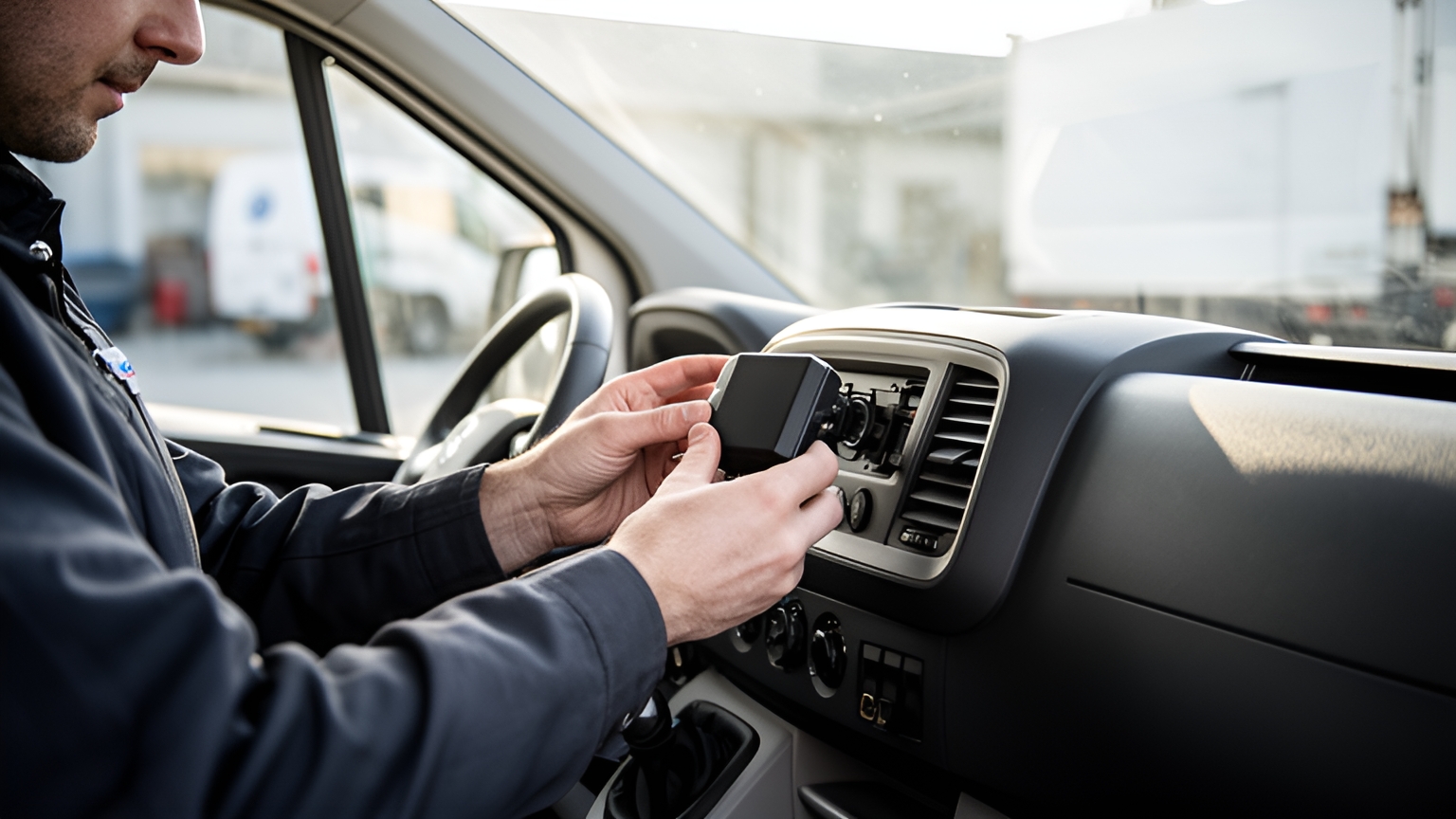
Fleet tracking prices can combine several parts: the in-vehicle device, installation, a per-vehicle subscription, the cellular data plan and optional modules such as cameras. Check whether a quote folds the base service into one monthly rate or charges extra GPS features as add-ons. To compare quotes fairly, divide the full contract cost by the number of vehicles, then by the number of months.
That last step matters more than any headline rate. Two quotes can show very different monthly numbers and still land close together per vehicle once the device, installation and contract length are counted. Or the cheaper-looking one can turn out dearer over a longer term.
What fleet tracking prices include, from the vehicle device to back-office reports
A fleet tracking system is a chain. A unit in the vehicle logs data and picks up its position by satellite. A mobile network carries that data, and software in the office turns it into maps, trip history and reports.
Every line on a quote pays for one link in that chain. These five terms do most of the work when you read one:
| Term | What it means on a quote |
|---|---|
| Device | The unit that logs data and picks up the vehicle's position. It may plug into the diagnostic port, be wired in by a technician, or run as an app on a driver's phone. |
| Data plan | The cellular connection that carries location and diagnostic readings to the office. It can sit inside the subscription or appear as its own line. |
| Per-vehicle subscription | The monthly charge for the software: the live map, trip history, reports, support and updates. |
| Add-on | An optional feature or module priced on top of the base, such as cameras, trailer and equipment trackers, or extra GPS features. |
| Buy-out | A payment to keep supplied devices when the contract ends, instead of returning them. |
Installation sits between the device and the subscription. A plug-in unit is quick to fit. A wired unit needs fitting time with the vehicle off the road, so ask who books the work and whether it's included.
Ask too which device options a provider supports, because the choice changes what you pay for hardware and fitting.
For a plain-English walk through how the signal travels from vehicle to screen, see this guide to how GPS fleet tracking works.
The office end deserves the closest reading, because it decides what your team can actually do with the data.
Madam Seafood shows that software layer at work. The family-run business delivers fresh and live seafood, from prawns and oysters to sashimi-grade products, to customers' doors across Adelaide, with weekly home delivery runs on Tuesdays and Fridays.
In its early years, every booking was handled by hand and routes were worked out after a long day on the fish farm, often into the early hours. As orders grew, that manual process could no longer keep pace, and customers regularly phoned to ask when their perishable orders would arrive.
Connecting Locate2u to its online store changed the routine. Orders flow straight in with the delivery date and time the customer chose at checkout. They're grouped by delivery window and turned into optimised routes for each driver run, and every customer receives a real-time tracking link, so they know when to expect their seafood with no phone call needed.
Madam Seafood's case study reports that the business automated 90% of its delivery workload with Locate2u route optimisation and the store integration, a result from one Adelaide food business rather than a fleet-wide benchmark.
For a buyer comparing prices, the useful detail is which capabilities did that work: the store integration, route optimisation and customer tracking links. Those are the items to find on every quote.
To test the same idea on your own routes, ask each provider to show, using your own orders, how jobs reach the routing screen and what a customer's tracking link looks like. Then check whether each sits in the base fee or costs extra.
How bundled base fees and paid GPS add-ons fit together on one quote
A quote can be built as one bundled rate, as a base fee plus paid add-ons, or as a mix of both. Neither model is better on its own. What matters is whether the features your team will use are inside the price you're comparing.
In a bundled model, the device, its installation and the data plan are folded into a single monthly rate per vehicle. The US federal government's leased fleet is one example: telematics installation and data plan costs are built into the monthly lease rate for every leased vehicle, whether or not it has telematics installed.
It's simple to budget, because one number covers the vehicle. If a quote is bundled, ask two things. Does the rate apply to every vehicle on the account, including any that don't have a device fitted yet? And does it pause while a vehicle is off the road for repairs?
In a base plus add-on model, the base fee covers core telematics and extra GPS features are sold as separate subscriptions. The same federal fleet shows this layer too, with additional GPS services available as an add-on subscription billed through the monthly leasing invoice.
Ask which features sit outside the base, such as how often locations update, geofence alerts, route replay, customer tracking links or camera footage.
Ask too whether add-ons appear on the same invoice, and whether they must be bought for the whole fleet or can be switched on for just the vehicles that need them.
Reading a mixed quote gets easier with a short routine:
- Write down the features your team will use from the first week, not the ones that look good in a demo.
- Mark each one on the quote as included or add-on.
- Price each add-on only for the vehicles that need it.
- Add those monthly amounts to the base fee before comparing anything.
That gives you a true monthly figure for the service you'll actually run. For a wider view of how software costs build up beyond tracking alone, see this guide to what fleet management software costs.
Questions that clarify device ownership, minimum vehicle counts and mid-term changes
The monthly rate is only part of the deal. The contract terms around it decide what you pay as vehicles come and go.
Put these questions to every provider and ask for the answers in writing. Answers set out the same way make quotes far easier to compare.
| Question to ask | Why it changes what you pay |
|---|---|
| Who owns the device during and after the contract? | Decides whether you return units, buy them out or keep them when the term ends. |
| Is there a minimum vehicle count? | A minimum above your fleet size means paying for vehicles you don't run. |
| How are vehicles added or removed mid-term? | Ask whether billing is prorated and who pays to move a device to a replacement vehicle. |
| Does the per-vehicle rate change as you add vehicles? | Shows what a growing fleet will pay, and whether a larger fleet moves onto different terms. |
| Are installation, removal and transfer charged separately? | Each is a one-off cost that belongs in the contract total. |
| Is the per-vehicle rate fixed for the term, and what happens at renewal? | Sets what the same fleet costs after the first term and how much notice a change needs. |
| Is pricing per fitted vehicle or per active user? | Changes how contractor drivers and shared vehicles are counted. |
| Which records can you export, and in what format? | Keeps your route and trip history useful if you ever change provider. |
Device ownership deserves extra attention. If the end of the contract means returning units or buying them out, that end-of-term cost belongs in the comparison, right beside the monthly fees.
Fleets that mix company vehicles with contractor drivers need one more check. A contractor's own vehicle may not suit a permanently fitted device, so count each group separately before adding them up.
If you'd like these questions answered for your own operation, book a call with the Locate2u team and bring your vehicle list.

Turning two differently built quotes into one cost per vehicle per month
Here's where careful reading pays off. Quotes built in different ways only become comparable when you reduce each one to the same unit: cost per vehicle per month, over the same contract term.
The method has three steps. Add every fee in the contract, one-off and monthly, for the full term. Divide by the number of vehicles. Then divide by the number of months.
Take two quotes for the same fleet. Quote A is bundled: one monthly rate per vehicle, with the device, installation and data plan included and nothing to pay upfront. Quote B charges for the device and installation upfront, then a lower monthly rate per vehicle that includes data.
Quote A's cost per vehicle per month stays flat, whatever the term. Quote B's falls as the term grows, because the upfront hardware is spread across more months.
So on a short contract, the upfront cost weighs heavily and the bundled quote can come out ahead. On a long contract, the lower monthly rate has more months to pay back the hardware, and the upfront quote can come out ahead instead.
To find the turning point, write both quotes in the same terms and swap in your own numbers. Call Quote A's monthly rate per vehicle A. Call Quote B's monthly rate per vehicle B, and its upfront device and installation cost per vehicle U.
Over a contract of T months, Quote A costs A per vehicle per month. Quote B costs B plus U divided by T.
The two match when T equals U divided by the gap between A and B. That answer is the break-even term in months. A contract shorter than that favours Quote A, and a longer one favours Quote B.
Check your working by putting the break-even term back into both formulas. Each quote should give the same cost per vehicle per month.
This is also why a headline monthly rate tells only part of the story. The lower monthly figure on a sales sheet can belong to the quote with hardware to pay first, and over a short term that can be the dearer option.
Before you trust the result, add the things a simple total can miss: any add-ons from your feature list, the end-of-term device cost from the ownership question, and the renewal rate if you expect to stay beyond the first term.
Run every quote on the same term, ideally the one you'd actually sign. A short-term total set against a long-term total tells you very little.
Putting tracking cost beside each vehicle's running cost per kilometre (mile)
Fleet tracking prices are easier to judge once the cost per vehicle sits next to what that vehicle already costs to run. Divide the monthly tracking cost per vehicle by the distance that vehicle covers in a month, taken from your own fuel or odometer records.
Use kilometres or miles, whichever your accounts already use, so the result sits on the same basis as everything else.
The same monthly tracking cost lands differently across a fleet. A van on long daily runs spreads it over many kilometres, so its tracking cost per kilometre is low. A vehicle that mostly works close to the depot carries the same monthly cost over far fewer kilometres.
Next, place that line on the same sheet as the vehicle's other running costs per kilometre: fuel, tyres, servicing, insurance and wages, all from your own accounts.
Two decisions follow. Low-distance vehicles carry a higher tracking cost per kilometre, so ask whether they can sit on a lighter service or a simpler device. And if tracking data helps planners trim distance from routes, set that saving per kilometre against the tracking cost, using your own figures.
What real-time visibility gives a dispatch team on a busy day
Price only makes sense next to what tracking does for the people using it. And the dispatch desk is where that value is easiest to see.
Picture a busy afternoon. An urgent order lands, one run is held up by traffic, and a customer wants to know when their delivery will arrive.
With a live map of every vehicle, the dispatcher can see which driver is closest to the new job and slot it in without a round of phone calls. Drivers keep driving instead of pulling over to read out their position.
When one run falls behind, the delay shows up as it happens. The next stop can pass to another vehicle, or the customer can hear about a revised arrival time before they need to ask.
Customer tracking links answer the arrival-time question directly. Each customer follows their own order, which frees the desk for the work that needs a person.
By the end of the day, timestamps and stop records give the office a clear history of every run, ready to inform tomorrow's planning.
Locate2u's real-time tracking brings these together, with a live view of every vehicle for the dispatch team and tracking links customers can follow. The same platform plans routes with route optimisation and records proof of delivery with photos, signatures and timestamps, so the day is planned, followed and documented in one place.
When you compare quotes, check where each of these sits. Live location updates, customer tracking links and dispatch tools can be part of the base service or separate add-ons, and the answer changes your cost per vehicle per month.
How widely fleets use telematics, and how that helps you shortlist with confidence
Telematics is a well-used tool, which shifts the buying question from whether to track to which quote fits your fleet best.
A 2018 analysis of fleet telematics found that some vehicles came with telematics installed as standard. Before paying for new hardware, check whether any of your vehicles already carry a factory-fitted unit, and ask each provider whether their platform can work with it.
For logistics specifically, Eurostat's figures for 2021 show that "IoT devices for logistics management were used the most in the transport and storage sector (61 %)." That share is of transport and storage enterprises that used the Internet of Things, not of every firm in the sector.
If your business already runs connected devices for logistics, such as handheld scanners or driver phones, ask each provider whether the tracking platform can work alongside them. That way you avoid paying for hardware to do a job a device you own already does.
The pool of vehicles on the road grows too. The U.S. Bureau of Transportation Statistics reports that 169.8 million trucks were operated on U.S. roadways in 2021, against 85.1 million in 2002.
If your own vehicle count could grow during the contract, price every quote twice: at today's fleet size and at the size you expect by renewal, using the growth question in the ownership table.
Then finish the shortlist with a pilot on a few representative vehicles. It shows real installation time, data use and the features your team reaches for, and it confirms which quote's cost per vehicle per month holds up on your own routes.
Frequently asked questions
What should happen to your tracking data when a contract ends?
Before signing, ask which records you can export, such as trip history, stop times and vehicle locations, in what file format, and how long they stay available after cancellation. Get the answer in writing so a future switch doesn't mean losing years of route history.
How do you budget tracking for a fleet that mixes company vehicles and contractor drivers?
Ask whether the quote is priced per fitted vehicle or per active user, because a contractor's own vehicle may not suit a permanently installed device. Count each group separately, then add them to get one monthly figure for the whole operation.
Is it worth piloting tracking on part of the fleet before committing?
Yes, a pilot on a few representative vehicles shows real install time, data usage and which add-ons your team actually uses. Ask whether pilot vehicles carry over onto the main contract at the same terms, so the setup work isn't repeated.
The quote that reads cheapest isn't always the one that costs least per vehicle. List every part of the price, get the ownership and contract answers in writing, and run each quote over the same term before you decide.
To see how tracking, dispatch and route planning work together on one platform, explore Locate2u's fleet management tools, then arrange a call to map tracking costs to your own fleet.